

Why Do Fast Food Chains Rely on Food Carton Packing Daily?
2026-09-30
During the lunch rush, a fast food kitchen produces 200 burgers in 45 minutes. Each burger must be wrapped or boxed, placed on a tray or into a bag, and delivered to the customer without delay. The packaging must be fast to assemble, strong enough to hold the product, and resistant to grease and moisture. If the Food Carton Packing fails—if the box leaks, if the lid pops open, if the customer receives a soggy container—the brand loses a customer. This is why fast food chains treat packaging as a critical operational component, not an afterthought. This guide explains how carton packaging is designed for the speed, durability, and brand visibility that daily fast food operations require.
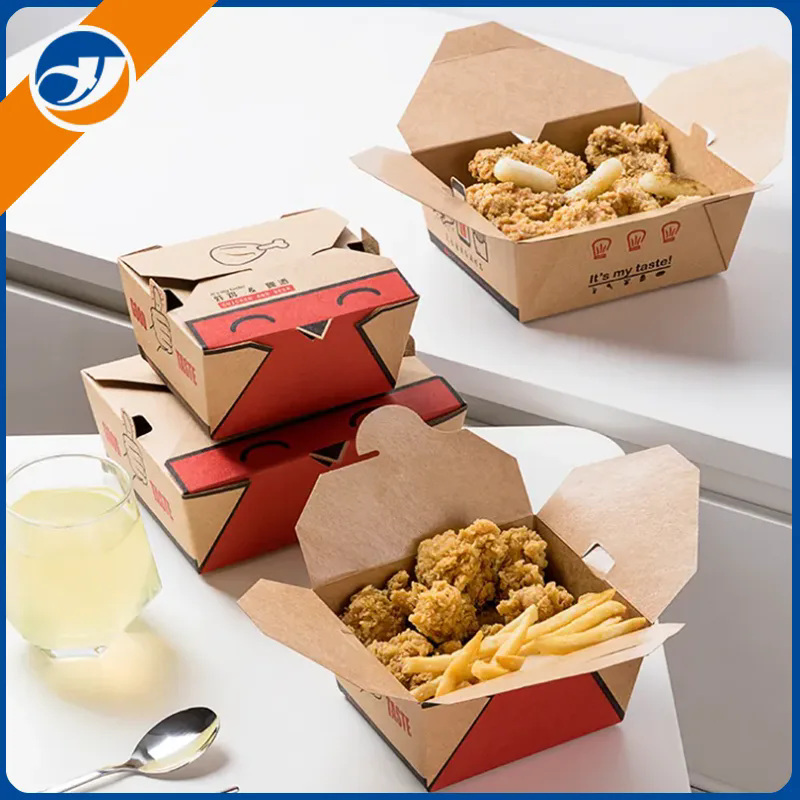
1. How Does Carton Design Affect Assembly Speed at the Counter?
Assembly speed is measured in seconds per unit. A burger carton that requires two hands and 8 seconds to assemble is 4 seconds slower than a carton that requires one hand and 4 seconds. Over 200 burgers, that difference is 800 seconds, or more than 13 minutes. During a lunch rush, 13 minutes is the difference between keeping the queue moving and losing customers. The fastest cartons use a one-piece design with a locking lid that snaps into place with a single push. The table below compares the assembly time for different carton designs.
| Carton design | Assembly time (seconds) | Hands required | Closure type |
| One-piece lock-top carton | 3 – 4 | One hand | Locking tab |
| Two-piece clamshell | 6 – 8 | Two hands | Hinge |
| Folding carton with tuck end | 5 – 7 | Two hands | Tuck flap |
| Paper wrap with sticker | 8 – 12 | Two hands | Adhesive |
In our factory, we design Food Carton Packing with a one-piece lock-top structure that assembles in under 4 seconds. The locking tab is tested for 5,000 open-close cycles to ensure that it does not lose its grip. Qingdao Zemeijia Packaging Products Co., Ltd. has been producing fast food cartons for over 10 years and supplies to chains across Asia and Europe.
2. Why Is Grease and Moisture Resistance Critical for Carton Performance?
Fast food products contain oil, sauce, and steam. A carton that is not resistant to grease will show oil stains within minutes. A carton that is not resistant to moisture will become soft and lose its strength. Both problems lead to customer complaints and brand damage. Grease resistance is achieved by applying a barrier coating to the carton board. The most common coatings are polyethylene (PE), polylactic acid (PLA), and water-based acrylic. The table below compares the performance of these coatings.
| Coating type | Grease resistance (Kit test) | Moisture resistance | Compostable | Relative cost |
| Polyethylene (PE) | 12 (excellent) | Excellent | No | Low |
| PLA | 10 (very good) | Good | Yes | Medium |
| Water-based acrylic | 8 (good) | Moderate | Yes | Medium |
| Uncoated carton board | 2 (poor) | Poor | Yes | Very low |
For hot, greasy products like fried chicken and burgers, we recommend a PE or PLA coating. For products with moderate grease content, such as sandwiches and wraps, a water-based acrylic coating is sufficient. Qingdao Zemeijia Packaging Products Co., Ltd. offers all three coating options and can advise on the best choice for your menu.
3. How Does Carton Packaging Support Brand Visibility and Customer Experience?
A fast food carton is a mobile billboard. Every customer who carries the carton out of the store, or receives it through a delivery app, sees the brand. A well-designed carton with high-quality printing reinforces the brand identity and creates a positive unboxing experience. The printing quality depends on the carton board and the printing method. Offset printing provides the highest resolution and color accuracy. Flexographic printing is more economical for large runs. Digital printing is suitable for limited editions and promotional packaging. The table below compares the printing methods for food carton packing.
| Printing method | Resolution | Color accuracy | Minimum order quantity | Best for |
| Offset lithography | 175 – 200 lpi | Excellent | 5,000 | Premium brand cartons |
| Flexography | 85 – 120 lpi | Good | 10,000 | Large volume, simple graphics |
| Digital printing | 150 – 200 lpi | Very good | 500 | Promotions, seasonal items |
The unboxing experience also depends on the structural design. A carton that opens easily without tearing, that keeps the product warm, and that can be recycled after use creates a positive impression. In our factory, we test the opening force for every carton design to ensure that it is easy for the customer to open but secure enough to prevent accidental opening during transport.
4. What Are the Cost and Sustainability Considerations for Daily Use?
Fast food chains use millions of cartons per year. The cost per carton is a significant line item. The cost depends on the board grade, the coating, the printing, and the order quantity. A standard PE-coated carton with one-color printing costs $0.08 to $0.12 per unit at 100,000 units. A PLA-coated carton with full-color printing costs $0.15 to $0.25 per unit. The sustainability considerations are also important. Many cities and countries have banned non-compostable packaging. A compostable carton made from FSC-certified board with a PLA coating meets these regulations and appeals to environmentally conscious customers. The table below shows the cost and sustainability profile for different carton options.
| Carton option | Cost per unit (100k units) | Compostable | Recyclable | Brand perception |
| PE-coated, 1-color | $0.08 – $0.12 | No | No (PE layer) | Standard |
| PLA-coated, 4-color | $0.15 – $0.25 | Yes | Yes (in industrial compost) | Premium, eco-friendly |
| Water-based acrylic, 2-color | $0.10 – $0.16 | Yes | Yes | Good |
| Uncoated, 1-color | $0.05 – $0.08 | Yes | Yes | Basic |
Operational tip: For chains that operate in multiple regions with different regulations, we recommend a single carton design that meets the strictest local requirement. This simplifies inventory and ensures compliance. Qingdao Zemeijia Packaging Products Co., Ltd. can produce a compostable carton that meets EU and North American standards.
Frequently Asked Questions About Food Carton Packing for Fast Food Chains
Summary for Fast Food Operations Directors
Food Carton Packing is a daily operational necessity for fast food chains. The carton must assemble quickly, resist grease and moisture, protect the product during transport, and reinforce the brand. The choice of board grade, coating, and printing method determines the performance and the cost. For chains that operate in multiple regions, a compostable carton that meets the strictest local regulations simplifies compliance and appeals to customers. Qingdao Zemeijia Packaging Products Co., Ltd. has been producing fast food cartons for over 10 years and supplies to chains worldwide.
Qingdao Zemeijia Packaging Products Co., Ltd. manufactures Food Carton Packing in a range of board grades, coatings, and printing options. We provide samples, strength test data, and regulatory documentation for all of our products.