Abstract
A flat rack container is a specialized shipping solution designed for oversized, heavy, or irregularly shaped cargo that cannot fit into standard enclosed containers. This article explains how it works, its structure, loading mechanism, key applications, advantages, and operational considerations. It also provides practical guidance for businesses seeking efficient project cargo transportation while minimizing risk, cost, and handling complexity.
Article Outline
-
Introduction to Flat Rack Containers
-
Structural Design and Key Features
-
Types of Flat Rack Containers
-
How Flat Rack Containers Work
-
Common Applications in Global Logistics
-
Loading and Securing Methods
-
Advantages and Limitations
-
Selection Guide for Buyers
-
Maintenance and Safety Practices
-
Frequently Asked Questions
Introduction
In global logistics, not all cargo fits neatly into standard shipping containers. Industrial machinery, construction equipment, vehicles, and large structural components often exceed conventional dimensional limits. This is where the flat rack container becomes essential.
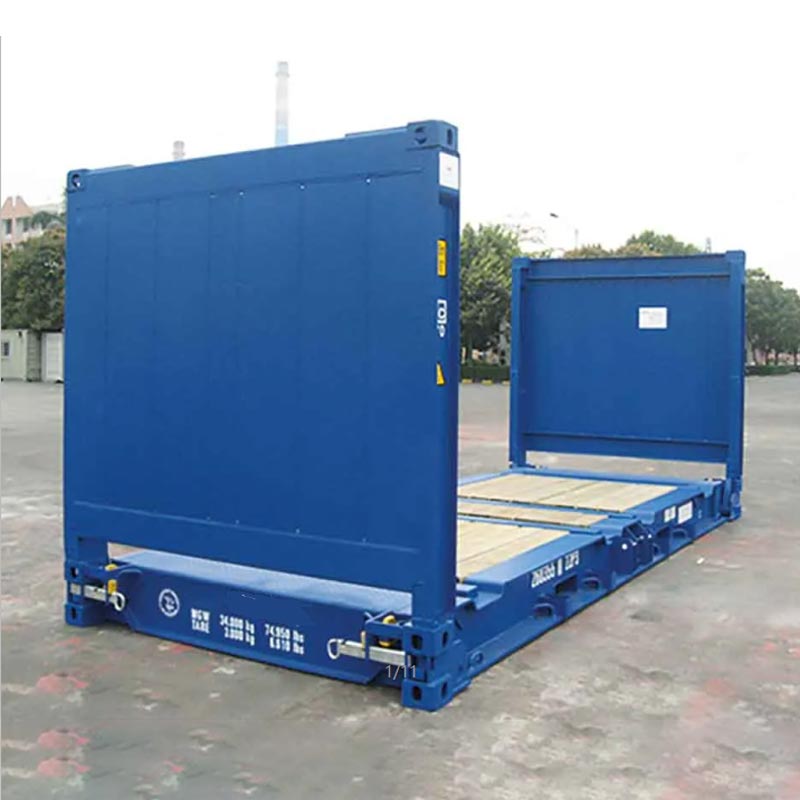
A flat rack container is engineered with a strong base and collapsible or fixed end walls, allowing cargo to be loaded from the top or sides. This design eliminates the constraints of enclosed walls and enables transportation of out-of-gauge freight across sea, rail, and road networks.
Industries such as energy, construction, mining, and manufacturing rely heavily on flat rack containers to move critical oversized assets efficiently and safely.
Structure and Key Features
The structural design of a flat rack container focuses on strength, flexibility, and accessibility. Unlike standard containers, it has no side walls and only partial end walls.
-
Reinforced steel base: Designed to support extremely heavy loads.
-
Foldable or fixed end walls: Provide cargo restraint while allowing flexibility.
-
Lashing points: Multiple securing points for straps, chains, and braces.
-
Forklift pockets: Enable efficient handling in ports and warehouses.
-
ISO compatibility: Designed for intermodal transport systems.
These features make flat rack containers highly adaptable for complex logistics operations involving non-standard cargo.
Types of Flat Rack Containers
|
Type
|
Description
|
Best Use Case
|
|
Fixed End Flat Rack
|
Rigid end walls that do not fold
|
Heavy machinery requiring strong containment
|
|
Collapsible Flat Rack
|
End walls can be folded down
|
Return shipping and space-saving storage
|
|
Platform Container
|
Flat base without end walls
|
Extremely oversized cargo or modular loads
|
Each type is selected based on cargo dimensions, return logistics, and structural stability requirements.
How It Works
A flat rack container works by removing the enclosure constraints of traditional shipping containers. Cargo is placed directly onto the reinforced base, either from the top using cranes or from the sides using heavy-duty forklifts.
Once positioned, cargo is secured using industrial-grade lashing systems attached to built-in anchor points. This ensures stability during ocean waves, rail vibration, and road movement.
-
Step 1: Cargo assessment and dimensional planning
-
Step 2: Loading via crane or forklift
-
Step 3: Positioning on reinforced base
-
Step 4: Securing with chains, straps, and braces
-
Step 5: Inspection before transport release
The entire process emphasizes structural balance and load distribution to prevent shifting during transit.
Common Applications
Flat rack containers are widely used across industries where cargo exceeds standard container dimensions.
-
Heavy construction machinery such as bulldozers and excavators
-
Industrial generators and turbines
-
Large steel structures and beams
-
Vehicles including buses, trucks, and boats
-
Oil and gas equipment modules
Their versatility makes them indispensable for project cargo logistics and international infrastructure development.
Loading and Securing Methods
Proper loading is critical to ensuring safety and stability during transportation. Because cargo is exposed, securing techniques are more complex than in enclosed containers.
-
Chain lashing: Used for extremely heavy industrial equipment
-
Webbing straps: Suitable for moderate-weight cargo
-
Wooden blocking: Prevents movement during transit
-
Welding brackets: Used in specialized industrial shipments
Incorrect securing can lead to cargo shifting, structural damage, or regulatory non-compliance.
Advantages and Limitations
|
Advantages
|
Limitations
|
|
Handles oversized cargo easily
|
Requires specialized loading equipment
|
|
Flexible loading from top and sides
|
Higher securing complexity
|
|
Strong structural capacity
|
Limited weather protection
|
|
Compatible with global transport systems
|
Higher logistics planning requirements
|
Despite limitations, the benefits far outweigh the constraints for industries handling irregular freight.
Selection Guide
Choosing the right flat rack container depends on several factors:
-
Cargo dimensions and weight distribution
-
Transport route conditions (sea, rail, road)
-
Loading and unloading infrastructure
-
Return logistics requirements
-
Budget and project timeline
A proper evaluation ensures efficiency, safety, and cost optimization throughout the shipping process.
Maintenance and Safety
Regular inspection and maintenance are essential to ensure structural integrity and compliance with international shipping standards.
-
Inspect lashing points for wear and deformation
-
Check base frame for corrosion or cracks
-
Ensure foldable ends function properly
-
Verify ISO corner fitting integrity
Safety protocols must always be followed during loading and unloading to prevent workplace accidents.
Frequently Asked Questions
What makes flat rack containers different from standard containers?
They lack side walls and allow open loading, making them suitable for oversized cargo.
Can flat rack containers be stacked?
Yes, they can be stacked when empty or when cargo is properly secured and weight-balanced.
Are flat rack containers weatherproof?
They offer limited protection; cargo is usually covered with tarpaulins if needed.
What industries use them most?
Construction, energy, mining, and heavy manufacturing industries rely heavily on them.
How is cargo secured?
Using chains, straps, welding brackets, and wooden blocking systems attached to lashing points.
Conclusion
Flat rack containers play a critical role in modern logistics by enabling safe and efficient transport of oversized and non-standard cargo. Their structural strength, flexible loading capabilities, and global compatibility make them essential for complex industrial operations.
For businesses seeking reliable flat rack container solutions with consistent quality and engineering support, Container Family provides professional-grade options tailored to demanding logistics requirements. To explore specifications, customization, and procurement support, Container Family contact us for expert assistance and project consultation.