

How Can a 7.5 Ton Crawler Excavator Improve Medium-Scale Earthmoving Projects?
2026-09-20
For contractors, construction companies, agricultural operators, and equipment distributors, choosing the right excavator is essential for balancing digging performance, operating flexibility, transportation, and project cost. A 7.5 Ton Crawler Excavator provides a practical combination of working power and machine size, making it suitable for medium-scale excavation, municipal construction, farmland development, landscaping, roadwork, and general earthmoving. With a crawler undercarriage, hydraulic working system, and flexible attachment options, this class of excavator can deliver stable performance across different jobsite conditions. Qingdao Pengcheng Glory Machinery Co., Ltd. focuses on providing reliable construction machinery solutions while supporting customized configurations for different customer requirements.
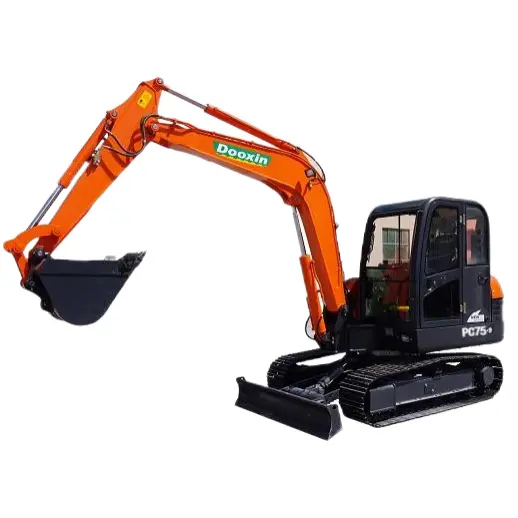
What Makes a 7.5 Ton Crawler Excavator Practical?
A 7.5-ton crawler excavator sits between compact excavators and larger heavy-duty machines. This positioning gives contractors enough digging force for demanding work while keeping transportation and site access more manageable.
Typical machines in this category have an operating weight of around 7,500 kg, bucket capacities around 0.28–0.30 m³, and digging depths of approximately 4 meters, although exact specifications vary by model and configuration. Publicly listed examples show that 7.5-ton machines can combine crawler stability with digging forces around 37–56 kN.
| Key Parameter | Typical 7.5-Ton Configuration |
|---|---|
| Operating Weight | About 7,500 kg |
| Bucket Capacity | About 0.28–0.30 m³ |
| Digging Depth | Around 4,000 mm |
| Maximum Digging Radius | Around 6,000+ mm |
| Travel System | Steel or rubber crawler options |
| Main Applications | Construction, agriculture, excavation, landscaping |
These specifications make the machine suitable for projects where a mini excavator may lack sufficient power but a larger excavator would be unnecessary.
Why Is Crawler Stability Important?
The crawler system is one of the most important components of a 7.5 Ton Crawler Excavator. Compared with wheeled machines, crawler excavators provide a larger contact area with the ground, helping improve stability and traction on uneven or soft surfaces.
This is particularly useful when the machine operates on:
-
Muddy or loose ground
-
Slopes and uneven terrain
-
Construction sites
-
Farmland and orchards
-
Roadside excavation areas
-
Landscaping projects
-
Rough earthwork environments
A stable undercarriage allows the operator to control the boom, arm, and bucket more precisely. It also helps maintain working stability when digging, loading, grading, or handling materials.
How Does It Improve Working Efficiency?
Efficiency is not simply about engine power. The interaction between hydraulic performance, working range, attachment selection, machine stability, and operator control determines the actual productivity of an excavator.
A properly configured 7.5-ton machine can support multiple operations without requiring a different machine for every task.
Main Working Functions
-
Excavation – Suitable for trenching, foundation preparation, drainage, and general earthmoving.
-
Loading – The bucket can move soil, gravel, sand, and other materials.
-
Grading – Appropriate attachments can improve surface leveling and site preparation.
-
Ditch Cleaning – Different bucket designs can be selected according to trench dimensions.
-
Demolition Support – Hydraulic breakers and other tools can expand the machine's working range.
-
Agricultural Work – The machine can support land preparation, irrigation, orchard construction, and related tasks.
Attachment compatibility is especially important because excavator attachments can significantly expand the functions of one base machine. Industry equipment documentation shows that buckets, breakers, grabs, grading tools, and other accessories can be configured according to specific working requirements.
What Role Does Customization Play?
Different customers rarely have exactly the same operating environment. Soil conditions, transportation restrictions, working space, attachment requirements, climate, and local regulations can all affect machine configuration.
This is where customized manufacturing becomes particularly valuable.
Qingdao Pengcheng Glory Machinery Co., Ltd. can provide configuration-oriented solutions for customers who require more than a standard excavator specification. Depending on the project, customization can involve working equipment, attachments, machine appearance, hydraulic configuration, track configuration, cabin options, and other details.
Supporting Ship-Type Customization
A notable advantage is the ability to support ship-type customization for customers with special application or appearance requirements. Rather than limiting customers to a single standard configuration, customized solutions can be developed around specific project conditions, machine functions, dimensions, and structural requirements.
For customers requiring a particular ship-shaped or special-form machine configuration, customization can help coordinate the machine's structural design with its intended working environment. This approach is especially valuable for specialized engineering projects, equipment distributors, and OEM customers who need a machine adapted to a particular market or application.
The purpose of customization is not simply to change the appearance. A properly engineered customized excavator should maintain the necessary balance between structural strength, hydraulic performance, operating stability, attachment compatibility, and practical usability.
Where Can a 7.5 Ton Crawler Excavator Be Used?
The versatility of this equipment makes it suitable for a broad range of industries.
Construction
Construction contractors can use the machine for foundation excavation, trenching, site preparation, material handling, and general earthmoving. Its medium operating weight provides a useful balance between working capacity and site mobility.
Agriculture
In agricultural projects, the excavator can support irrigation channels, land preparation, drainage construction, orchard development, and other earthwork.
Municipal Engineering
Roadside maintenance, drainage systems, utility construction, landscaping, and small-scale infrastructure projects often require a machine that can work efficiently without the footprint of a larger excavator.
Landscaping
For parks, gardens, private developments, and landscape construction, different buckets and attachments can help operators perform excavation, grading, soil handling, and site preparation.
Mining and Earthwork
A 7.5-ton machine can also support selected light-to-medium earthmoving and material-handling tasks where its operating range and digging capability match the project requirements.
How Does Equipment Configuration Affect Results?
The final working effect depends heavily on selecting the correct configuration before production.
| Customer Requirement | Recommended Consideration |
|---|---|
| Soft or uneven terrain | Stable crawler undercarriage |
| General excavation | Standard digging bucket |
| Hard materials | Hydraulic breaker configuration |
| Narrow working areas | Appropriate machine dimensions |
| Agricultural applications | Suitable bucket and working equipment |
| Special projects | Customized boom, arm, attachments, or configuration |
| OEM distribution | Logo, color, specification, and configuration customization |
| Special-form projects | Ship-type or application-oriented customization |
For OEM and wholesale buyers, this flexibility can also simplify product differentiation. Instead of offering exactly the same standard machine as every competitor, distributors can develop configurations around their local market requirements.
Why Choose Qingdao Pengcheng Glory Machinery Co., Ltd.?
Qingdao Pengcheng Glory Machinery Co., Ltd. provides construction machinery solutions covering crawler excavators and other equipment categories. Its product information describes a manufacturing system covering cutting, welding, assembly, and quality-control processes, while important components are sourced from established brands.
For the 7.5-ton crawler excavator, the listed DX75PC-9 configuration includes a 7.5-ton operating weight, 0.3 m³ bucket capacity, 36.2 kW Yanmar engine, 4,080 mm maximum digging depth, and 6,270 mm maximum digging radius.
The machine also incorporates features such as hydraulic cylinder protection, high-strength rollers and tracks, multi-stage air filtration, and a spacious operator cab. These components are designed to support durability, stable operation, maintenance convenience, and operator comfort in demanding working environments.
What Should Buyers Consider Before Ordering?
Before purchasing a 7.5 Ton Crawler Excavator, professional buyers should evaluate more than the basic machine price.
Consider these factors:
-
Operating weight and transportation requirements
-
Engine power and emission requirements
-
Bucket capacity and digging force
-
Maximum digging depth and reach
-
Track width and ground clearance
-
Hydraulic system configuration
-
Required attachments
-
Working environment and terrain
-
Local certification requirements
-
Spare-parts availability
-
OEM and customization requirements
-
After-sales technical support
For customized projects, providing information about the application, required working range, attachments, transportation restrictions, and special structural requirements can make the configuration process more accurate.
Conclusion
A 7.5 Ton Crawler Excavator offers a practical balance between power, stability, flexibility, and operating cost for a wide range of medium-scale earthmoving applications. Its crawler undercarriage provides reliable ground stability, while hydraulic attachments allow one machine to perform excavation, grading, ditching, material handling, and other tasks.
For contractors, distributors, and OEM buyers looking for more than an off-the-shelf machine, customization can add further value. From working equipment and attachments to appearance, dimensions, and ship-type customization, Qingdao Pengcheng Glory Machinery Co., Ltd. can develop equipment solutions around specific application requirements.
If you are looking for a reliable 7.5 Ton Crawler Excavator for construction, agriculture, municipal engineering, landscaping, or a customized project, contact us to discuss your required specifications, working conditions, attachments, and OEM customization needs.