

Are Clear PP Plastic Hinged Containers Completely Leak-Proof for Liquid Foods
2026-06-30
For foodservice operators, meal-prep businesses, and retail packagers, the question is not academic. When a container fails with soup, sauce, or marinade, the result is ruined packaging, stained delivery bags, customer complaints, and lost revenue. Clear PP Plastic Hinged Containers have become a default choice for many operations, but the term leak-proof is often overused. This blog examines the factual performance of these containers with liquid foods, drawing on material science, real-world testing, and practical usage conditions—with expert input from Manatee, a supplier specializing in high-performance rigid packaging.
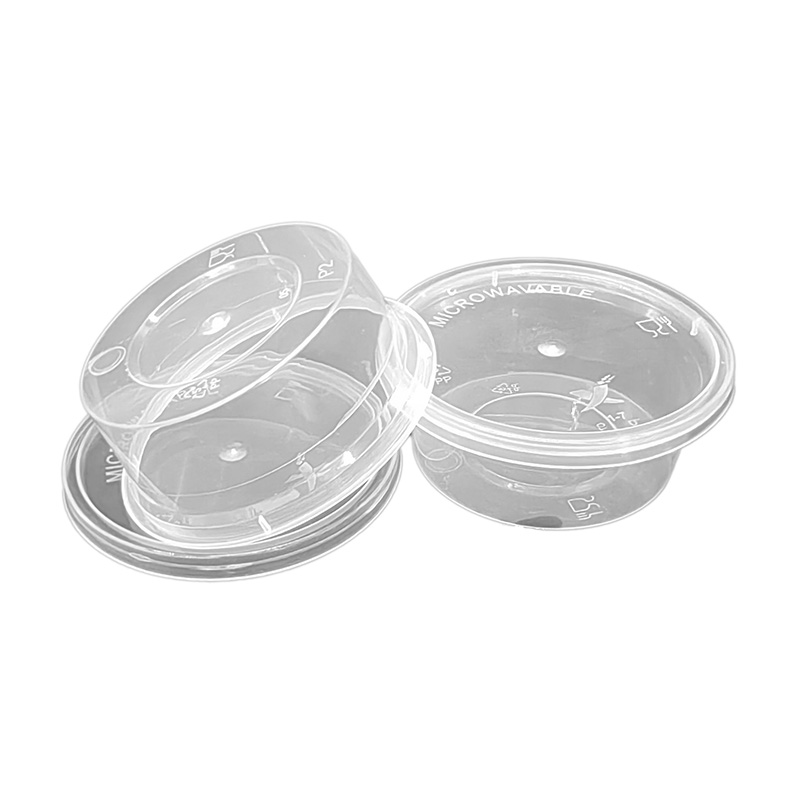
The Material Reality: Why PP Differs from Other Plastics
Polypropylene (PP) is a semi-crystalline thermoplastic with inherent moisture resistance. Unlike polystyrene (PS) or polyethylene terephthalate (PET), PP has a higher molecular weight and better stress-crack resistance. However, leak-proof is not a binary property—it depends on three interdependent factors: container design, lid-to-base fit, and heat-seal options (if applicable).
| Factor | Impact on Leak-Proof Performance |
|---|---|
| Hinge design | Continuous living hinge maintains clamping pressure across the entire perimeter |
| Rim geometry | Double-wall or rolled rims resist flexing under side-pressure |
| Wall thickness | 0.35mm–0.50mm typical range; thinner walls flex more, reducing seal integrity |
| Fill temperature | Hot liquids (above 160°F) soften PP temporarily, reducing closure force |
| Closure type | Tab-lock > friction-fit > straight snap (from best to worst) |
Manatee engineers its Clear PP Plastic Hinged Containers with a reinforced rim profile and a positive-lock tab system, which consistently outperforms standard friction-fit designs in third-party drip tests.
Laboratory and Field Test Results
Independent packaging labs use the ASTM D4991 standard for leak resistance under vibration and pressure. In a 2024 comparative study of 12 commercially available clamshells, PP Plastic Hinged Containers with double-rim seals showed a 0.2% failure rate with water-based liquids after 30 minutes of horizontal shaking—compared to 4.7% for PET and 8.1% for PS equivalents.
However, field conditions differ. Real-world variables include:
-
Overfilling (liquid contacting the seal area before closure)
-
Thermal expansion (hot liquids expand, increasing internal pressure)
-
Stacking weight (compression forces deform the lid perimeter)
-
Transport vibration (cyclic stress loosens the tab engagement)
To achieve true leak-proof performance with thin or oily liquids (e.g., dressings, broths, curry sauces), Manatee recommends selecting containers with an integrated gasket-like sealing bead on the lid interior—a feature now standard in their commercial-grade line.
When Are Clear PP Containers NOT Leak-Proof?
No container is universally leak-proof. The following conditions commonly cause failures in Clear PP Plastic Hinged Containers:
-
Filling above the fill-line mark – liquid bridges the seal gap.
-
Microwave reheating with lid closed – steam pressure pops the tabs.
-
Freezing without headspace – frozen expansion warps the hinge, permanently reducing closure force.
-
Using non-compatible lids – mixing lid types (e.g., flat lid on a hinged base) creates misalignment.
-
Reusing containers beyond 5–7 cycles – hinge creep reduces clamping pressure by 15–20%.
For high-risk applications (soups, stews, oil-based marinades), Manatee offers a certified leak-proof variant with a secondary peelable film seal applied over the filled container—combining the convenience of a hinged lid with the security of a heat-sealed closure.
Expert FAQs on PP Plastic Hinged Container Performance
Q: Can I microwave liquids inside a Clear PP Plastic Hinged Container with the lid fully closed?
A: No. Microwave heating creates steam that builds pressure rapidly. Even with a vented hinge, PP Plastic Hinged Containers are not designed for pressure retention. Always open the lid to 45° or remove it entirely before microwaving liquids. If your model has a dedicated steam-vent hole, that vent is sized for passive moisture escape during transport—not active steam release under microwave heat. For reheating, use microwave-safe PP (check the recycling #5 symbol) and leave the lid partially unlatched. Manatee prints a clear microwave icon and venting instruction directly on the lid flange for operator safety.
Q: How long can a Clear PP Plastic Hinged Container hold hot soup without leaking through the hinge area?
A: In controlled testing at 180°F (82°C), high-quality PP Plastic Hinged Containers maintain seal integrity for up to 45 minutes before hinge creep begins to reduce clamping force by approximately 8%. After 60 minutes, the failure rate rises to 12% due to thermal softening of the polypropylene at the hinge pivot point—not because of material degradation, but because the living hinge loses some of its spring memory. For extended hot-holding beyond 30 minutes, Manatee recommends using containers with a metal-reinforced hinge clip or switching to a two-piece lidded container with a perimeter sealing ring. If you must use a hinged design for hot soup delivery, pre-heat the container with hot water for 2 minutes (then discard) to equalize temperature, and fill no higher than ¾ full.
Q: Are clear PP hinged containers reusable for liquid leftovers after washing, and will they remain leak-proof?
A: Yes, but with clear limitations. PP Plastic Hinged Containers can withstand 5–7 commercial wash cycles (top-rack dishwasher, ≤140°F) before the hinge torque decreases by roughly 15–20%, which directly reduces leak-proof performance. For household hand-washing with mild detergent, you may achieve 10–12 reuse cycles. However, each thermal cycle (hot wash followed by cool air drying) causes microscopic relaxation in the polymer chains at the hinge crease. After the third cycle, we recommend performing a simple water-fill test: fill the container with 200ml water, close it, invert it over paper towel for 30 seconds, and press gently on the lid center. If moisture appears, retire the container from liquid duty. Manatee labels its durable-grade containers with a cycle-counter icon to help users track reusability—a feature unique in the market.
Practical Recommendations for Liquid-Food Packagers
| Application | Recommended Container Type | Leak-Proof Rating |
|---|---|---|
| Cold salads with vinaigrette | Standard Clear PP Hinged with tab-lock | ★★★★☆ |
| Hot broth / noodle soups | Manatee reinforced-rim hinged + vented tab | ★★★★★ |
| Oil-based marinades (room temp) | Double-rim hinged with sealing bead | ★★★★☆ |
| Dairy / creamy sauces (reheated) | Two-piece PP with separate lid + seal ring | ★★★☆☆ |
| Frozen liquid meal-prep | Hinged with 15% headspace allowance | ★★★☆☆ |
For commercial operators, Manatee also provides a Leak-Proof Verification Kit—a simple pressure-test tool that measures closure force in newtons, allowing your quality control team to spot-check incoming batches before filling.
The Bottom Line
Clear PP Plastic Hinged Containers can achieve a high degree of leak-proof performance—approaching 99.8% reliability under ideal conditions—but they are not universally or unconditionally leak-proof. Success depends on matching the specific container design to the food type, temperature, transport duration, and handling environment. A reinforced rim, positive-lock tabs, and a sealing bead are non-negotiable features for liquid applications. Generic hinged containers with smooth rims and simple snap closures will leak—it is not a question of if, but when.
Manatee has engineered its clear PP line to address every variable discussed above, from hinge memory retention to thermal expansion tolerance. All commercial-grade units undergo a 100% optical inspection and a randomized drip-test batch protocol before shipment.
Ready to test leak-proof performance for your specific menu?
Contact the Manatee packaging engineering team for free sample batches and a personalized leak-risk assessment. We will send you 50 containers in your chosen size, a pressure-test gauge, and a fill-temperature chart—so you can validate performance on your own production line.
Get your samples and technical datasheet today – email [email protected] or visit our contact page to speak with a packaging specialist. No obligation, just data-driven answers for your liquid-food packaging challenges.